
JEPA Amendment 2 – June 3, 2020
June 3, 2020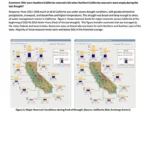
Major California Reservoir Conditions During Peak of 2012-2016 Drought
June 15, 2020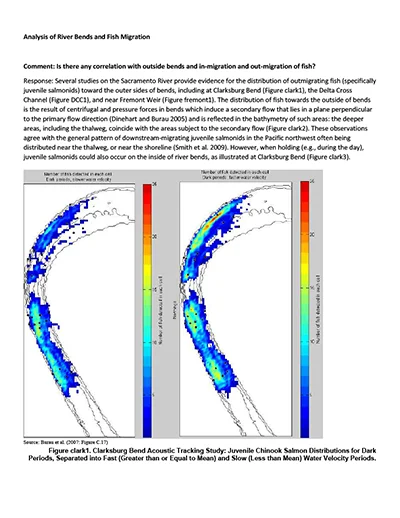
Analysis of River Bends and Fish Migration
- Version
- File Count 1
- File Size 932 KB
- Publish Date June 4, 2020
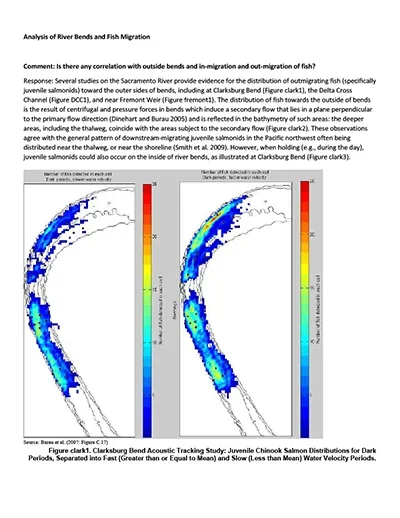
Several studies on the Sacramento River provide evidence for the distribution of outmigrating fish (specifically juvenile salmonids) toward the outer sides of bends, including at Clarksburg Bend (Figure clark1), the Delta Cross Channel (Figure DCC1), and near Fremont Weir (Figure fremont1). The distribution of fish towards the outside of bends is the result of centrifugal and pressure forces in bends which induce a secondary flow that lies in a plane perpendicular to the primary flow direction (Dinehart and Burau 2005) and is reflected in the bathymetry of such areas: the deeper areas, including the thalweg, coincide with the areas subject to the secondary flow (Figure clark2). These observations agree with the general pattern of downstream-migrating juvenile salmonids in the Pacific northwest often being distributed near the thalweg, or near the shoreline (Smith et al. 2009). However, when holding (e.g., during the day), juvenile salmonids could also occur on the inside of river bends, as illustrated at Clarksburg Bend (Figure clark3).